Why Germany Became Famous for FKK Culture
FKK means Freikörperkultur, free body culture. How a 1795 essay, Weimar clubs, and the GDR made Germany famous for nudism.
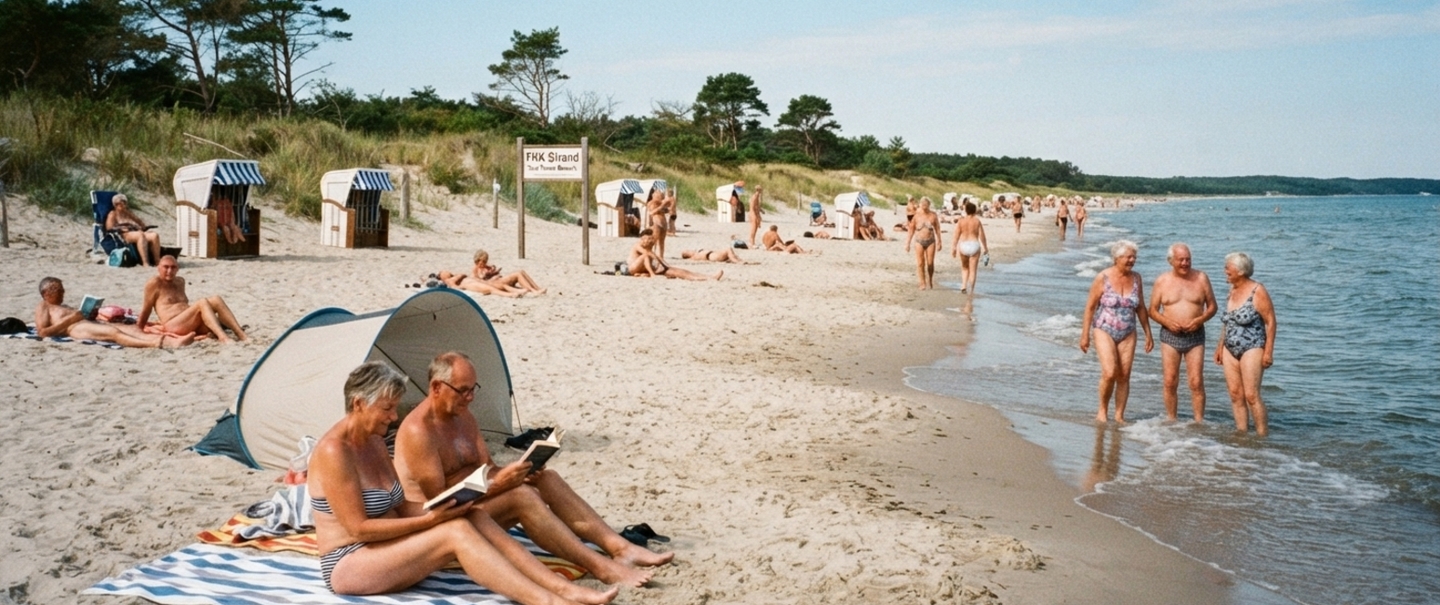
FKK stands for Freikörperkultur, which translates literally as free body culture. You'll see the three letters on beach signs, spa doors, and lake notices across Germany, and, in a different universe entirely, on adult club advertising. The core meaning is simple: social nudity that isn't about sex. An FKK-Strand, a designated nude beach, treats being undressed as unremarkable, the way a restaurant treats shoes.
Every European country has some relationship with naked bathing. France gave the world the bikini and the Riviera, and the Nordic countries have sauna customs older than most of their written records. Yet Germany is the country foreigners name first on the subject, and if you've spent any time there, you've probably walked past the evidence without noticing it. That didn't happen because Germans are less embarrassed than anyone else. It happened because a health movement, a mass political movement, and a Cold War state each pushed the habit further than it would have traveled on its own.
What FKK Actually Means
Freikörperkultur is usually translated as free body culture, and the phrase carries more ideology than the English suggests. In German usage it describes a whole attitude: sun, air, exercise, and the conviction that the body is nothing to hide. When English writers drop the umlaut you'll see it spelled freikorperkultur, and it's the same word doing the same work.
Germans attach the abbreviation to almost anything unclothed and non-sexual. A campsite, a section of a lake, a pool evening, a sauna. What you won't find in the original meaning is eroticism, and the distance between the two meanings matters enough that we'll come back to it, because the story of how the letters migrated from wellness to adult entertainment is the strangest part of this history.
It Started With a Calendar Essay
In 1795, the Göttingen scientist and satirist Georg Christoph Lichtenberg published an essay called The Air Bath, Das Luftbad in the original, in a pocket calendar. His advice was to spend time naked in open air and sunshine the way animals do, on the theory that the human body was built for exactly that condition and damaged by everything wrapped around it. Lichtenberg wrote with a wink. The essay is playful rather than programmatic, but the claim underneath it, that light and air act on health directly, would be repeated by respectable physicians for the next 150 years. You can read the whole thing in a few minutes, and it holds up better than most health advice from the 1790s.
The medical version arrived in the 1850s. Arnold Rikli, a Swiss naturopath, opened a sanatorium in Bled, then the Austrian town of Veldes, in 1855, and built his practice on what he called atmospheric cures: sunbathing, cold water, walking and resting outdoors without clothing, at prescribed hours and in prescribed doses. Patients traveled to him from across Europe. Rikli's core idea, that sunlight is a therapy in its own right, sounds less eccentric today than it did then, and it did something more durable than any single cure. It put nudity inside a medical frame where moral objections had trouble reaching.
A broader mood fed both men. Lebensreform, literally life reform, was a loose movement that blamed industrial city living for the ailments of the age: bad air, sedentary work, alcohol, tight clothing. Its prescriptions ran from vegetarianism to garden cities to loose reform dress, and nakedness fit the program without strain. If the problem is everything modern life wraps around the body, the boldest answer is to remove the wrapping. The painter Karl Wilhelm Diefenbach turned that idea into an art practice, running vegetarian and nudist communes, first near Munich and later at Himmelhof outside Vienna, and he died on Capri in 1913 as something close to the movement's first celebrity.
By 1906, Sunlight Was a Prescription
The idea had buildings by the start of the twentieth century. In 1906, Germany counted 105 air-bath sanatoriums, called Lichtbäder or Luftbäder in German, where patients were treated in the open air, often undressed, a practice that had already acquired its own name: free body culture, or Freikörperkultur.
The first dedicated club is usually credited to Essen in the 1890s, and it grew out of a natural-healing association rather than out of any scandal. The Essen association's own records begin in 1893, and its descendant club still exists today as the Licht-Luft-Sportgemeinschaft Essen. That origin describes the early movement as a whole: most members were health enthusiasts first, and the nudity was the method, not the point. Germany's first official nude beach is usually credited to Sylt in 1920, though the island's own records put its first police permit for nude bathing in 1927. Either way, by the 1920s the practice had moved from prescription to ordinary leisure, which is the transition that made everything after it possible.
The Weimar Republic Made It a Mass Movement
Organized nudism grew faster in the 1920s than almost anything else in German leisure culture. In 1923 most FKK associations joined into a national working group whose name translates as the Working Group of the Leagues for German Light Campaigners. A monthly magazine, Leben und Sonne, meaning Life and Sun, was published in Berlin from 1925. In 1926 the umbrella body was renamed the Reich Association for Freikörperkultur, which made the movement's national scope official.
The socialist wing did the heavy lifting. Adolf Koch, a Berlin schoolteacher and Social Democrat, ran nude physical education classes that began with parents' groups in 1923, became a private school in 1924, and received a state permit in May 1926. By 1931 there were thirteen Koch schools across Germany. If that sounds improbable for the 1920s, note the permit: the German state licensed nude schooling and then kept licensing it. The workers' federation Freie Menschen, Free People, counted roughly 70,000 members in 1932, and organized FKK overall reached about 100,000 people by the end of the Weimar Republic. Those are dues-paying members, not casual beachgoers, and they came from ordinary jobs rather than from the artistic fringe.
The movement also went international. In June 1930, delegates from eight countries met in Frankfurt and founded a European naturist union within about a year, the forerunner of today's International Naturist Federation, which was founded in France in 1953. One crankish essay in a pocket calendar had become, inside 135 years, a movement with schools, magazines, leagues, and an export market.
The Nazis Banned It, Then Quietly Unbanned It
One of the first things the Nazis did upon taking office was ban nudism. On 3 March 1933 the Prussian interior ministry under Hermann Göring issued a circular against it, and the FKK clubs were then dissolved or absorbed into Nazi organizations. The motive was a mixture of the obvious: the movement's membership was heavily socialist, its networks internationalist, and its practice offensive to the regime's idea of public morals. You can measure how mainstream the movement had become by how early in the regime's life the order arrived.
The ban was never as complete as the order implied. In early August 1939, weeks before the war began, German naturists traveled to Thielle in Switzerland for the first naturist Olympics. On 10 July 1942, the Reich relaxed the prohibition by ordinance: nudity was allowed wherever nobody had to see it. The clause reads like a loophole because it is one, but it mattered enormously. It stayed in force in West Germany into the 1960s and in East Germany until 1990. You can trace that wording straight into postwar law, which means the legal right to be naked, discreetly, survived the Third Reich, the war, and the occupation.
East Germany Made Nakedness Ordinary
The strangest chapter is the GDR's, and it opens with a failed crackdown. The young state moved against FKK in the early 1950s, and in August 1954, after raucous nude parties at the Prerow campsite on the Baltic coast, parties that participants called Kamerun, it banned nude bathing along the entire coast. Johannes R. Becher, the culture minister and a respected poet, backed the ban with the slogan Spare the eyes of the nation.
The population ignored it, loudly. Protests followed along the coast, and in 1956 a new ordinance allowed nude bathing in designated or screened areas. Once the state had conceded the principle, FKK spread through East German society at every level: factory holidays, campsites, beaches, allotment gardens. By the 1970s, nakedness at the beach was an East German normality that cut across every social line, and the Prerow campsite had become its unofficial capital, drawing up to ten thousand visitors in peak seasons. That's a scale you don't reach with a fringe hobby.
If your image of East Germany comes from spy novels, this is the detail that corrects it. In a state that organized work, housing, travel, and leisure down to the neighborhood, nudity was one of the few things the party never fully controlled, and people guarded it with particular stubbornness. That's an interpretation rather than a documented finding, but it's a hard one to avoid. Textilfrei, the German adjective for clothing-optional, became ordinary vocabulary in the east precisely because the practice itself was ordinary.
Why Germany, and Not France or Scandinavia
Look at the sequence and the answer to why Germany, specifically, is mostly structural. Medical legitimacy came first and earliest: an essay in 1795, a sanatorium in 1855, 105 air-bath clinics by 1906. Nude bathing customs existed elsewhere, but no other country built so many sanatoriums, clubs, magazines, and federations around the practice, or built them so early, decades before any neighboring country treated the idea as more than eccentric. Respectability is the difference between a habit and a culture, and Germany industrialized it first.
Then the Weimar movement gave it mass, and the socialist wing gave it ordinary members rather than bohemians. Then the GDR, of all states, made nakedness a default rather than a choice. Two German states, one capitalist and one communist, arrived at the same everyday tolerance by completely different routes, and that coincidence is what fixed the reputation abroad. A visitor to either side of the border from the 1960s onward saw the same thing on the beach.
There's also a plainer reason underneath. Customs without institutions die quietly whenever public morals shift against them. Germany's institutions meant that when one authority banned the practice, a law, a club register, or a magazine survived somewhere to restart from. The habit kept being relaunched from paperwork, and the paperwork is why you can read this story in detail at all.
From Freikörperkultur to FKK Clubs
Now for the part that confuses visitors, and more than a few Germans. From the early 1980s, commercial venues began calling themselves FKK clubs. These are brothel-type establishments built around sauna facilities, and their connection to the naturist movement is nominal. The term has no legal protection in Germany, so any business can put the three letters on its door, which is why you now see them in contexts Lichtenberg never imagined.
Why would the adult industry want a century-old wellness word? Our read is that the borrowing did exactly what it was designed to do. FKK promises health, naturalness, and unforced social ease, which is a far more comfortable frame for a brothel than anything explicit the industry could invent. The word launders the venue, not the activity. It's a clever piece of naming, and it has produced decades of confusion between two things that share nothing but a name.
The two worlds run on entirely different rules. Non-sexual nudity depends on nobody treating a body as an invitation, while commercial clubs are built on the opposite premise, and it pays to know which one you're walking into before you go. If you book an FKK club expecting a naturist spa, you'll discover the difference quickly and expensively. We cover the distinction in detail in our guide to common myths about FKK clubs.
Where FKK Culture Stands Today
Organized naturism is shrinking, and the numbers are not subtle. Membership in the main club federation fell from about 150,000 in the early 1970s to about 60,000 by the late 1990s, and to roughly 33,000 to 35,000 in recent counts. If you've heard that German nudism is dying, this is where that story starts: nudist clubs report slumping membership, and the club scene skews older every year. The generational drop is measurable even where the habit was deepest: surveys of young East Germans put FKK experience at about 90 percent in the late GDR years and near 50 percent by 2013.
None of this means the practice is vanishing. It survives wherever you don't need a membership card. Mixed sauna nudity remains the default rule in most German spas, and FKK-Strand signs still mark sections of beach on both the North Sea and the Baltic. What's fading is the organized version, the club with its dues and its rulebook, which may be the least surprising outcome available.
The Takeaway: A Habit Built on Paperwork
That's a fitting end for a movement that began as a doctor's prescription. Germany became famous for FKK culture because it was the one country that turned nakedness into institutions: clinics first, then clubs, then federations, and finally a state that made the practice ordinary. Institutions age. The underlying habit no longer needs them the way it once did, and what remains is what you can still see at any German lake in summer.
For a visit of your own, our complete guide to FKK clubs in Germany covers what to know before your first visit, from etiquette to what the letters on the door actually mean.
 Countries Where Brothels Are Legal (2026 Guide)
Brothels are legal in fewer places than most people think. See where, what 'legal' means in each country, and what changed in 2026.
1 week ago
Blog
 Which Adult Entertainment Experience Would You Choose? A Look at 5 Different Options
Strip club, swinger club, FKK spa, brothel or escort: what each is actually like, what it costs, and which one suits your first night out.
3 weeks ago
Blog
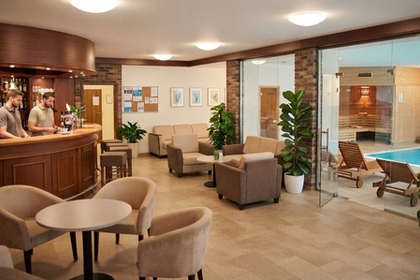 Things You Probably Didn't Know About FKK Clubs
Who pays whom inside a German FKK sauna club, why Berlin apologized to a brothel, and the house rules nobody warns you about.
4 weeks ago
Blog
 Strip Club Reviews: How to Spot Fakes & Pick a Great Club
A 4.9 built on six reviews is not better than a 3.1 built on forty-one. Learn the fake-review tells, why the 3-star reviews are the honest ones, and the five-minute check that picks your club before you pay the cover.
1 month ago
Blog
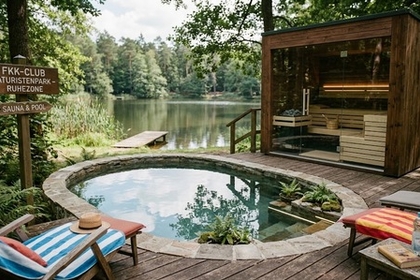 Why Germany Became Famous for FKK Culture
FKK stands for Freikörperkultur, free body culture. Here's how a Swiss doctor's sunbath cure became Germany's national habit, and how its initials ended up over the door of sauna clubs.
1 month ago
Blog
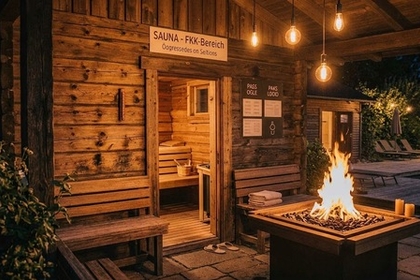 Common Myths About FKK Clubs (And What German Sauna Clubs Are Really Like)
Half the internet thinks FKK clubs are nudist spas. The other half thinks they're illegal. Neither is right. Ten myths about German sauna clubs, checked against the law, the operators' own price pages, and what the women working there actually say.
2 months ago
Blog
 10 Myths About Brothels That Aren't True
Ten brothel myths, checked against actual law rather than slogan. Where they're legal, who really visits, what workers keep, and why you'll never find a posted price. With the parts that are true.
2 months ago
Blog
 7 Escort Agency Booking Mistakes First-Time Clients Make (And How to Avoid Them)
Most first-timers don't lose money on escort agency bookings because of bad luck - they skip the vetting, send the wrong first message, or pay a "deposit" in gift cards. Here are the seven mistakes that actually cost people money, and the fix for each.
3 months ago
Blog
 Europe Sex Guide: Best Cities for Adult Nightlife 2026
15 European sex capitals, fact-checked for 2026: what's legal, what a night really costs, and which famous spots are tourist traps.
3 months ago
Blog
 What Couples Need to Know Before Visiting a Swinger Club
Thinking about visiting a swinger club as a couple but not sure what you're actually walking into? This is the honest, no-judgment guide we wish every couple had before their first night - the conversation to have beforehand, how to set boundaries you'll both hold, the etiquette nobody explains out loud, and what the night really feels like.
3 months ago
Blog